
The Difference Between "I Fixed a Database Issue" and a Senior-Level Answer
Same experience. Completely different signal.

I used to say things like this in interviews:
“I fixed a database issue that was causing timeouts.”
“I optimized some slow queries.”
“I helped debug a production incident.”
I had done all of these things. Real systems, real pressure, real fixes.
But every time I said it out loud, it landed flat.
The interviewer nodded politely and moved on.
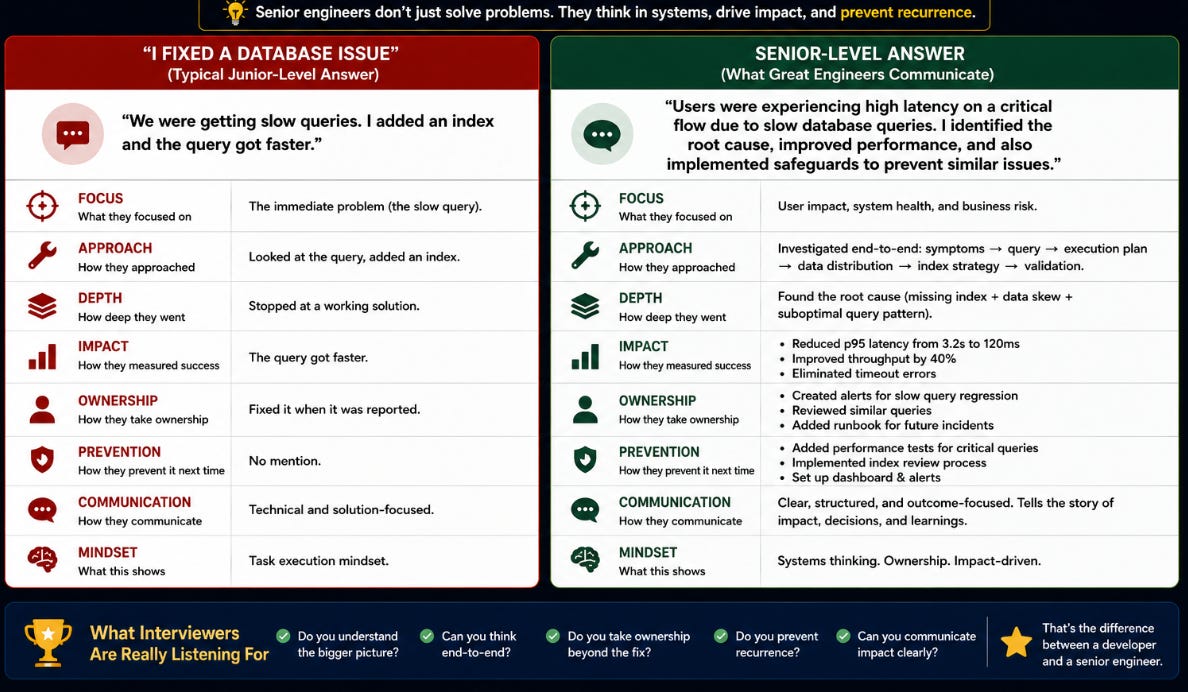
A few months later, I watched a colleague answer the same type of question.
He said:
“We had connection pool exhaustion causing cascading timeouts across three services during a traffic spike. I isolated the scope, identified the slow query holding connections open, increased the pool size as an immediate fix, then rewrote the query and added monitoring to catch it earlier next time. We went from a 40-minute outage to a 6-minute recovery window on the next similar incident.”
Same kind of experience. Completely different signal.
He got the offer. I didn’t.
The problem isn’t your experience.
Most engineers who struggle in senior interviews have done real work. They’ve handled real incidents. They’ve made real decisions.
The problem is structure.
When you say “I fixed a database issue” the interviewer hears junior. Not because the work was junior. But because the framing is.
Senior engineers don’t describe what they did. They describe what happened, why it happened, what they decided, what tradeoffs they made, and what they put in place so it wouldn’t happen again.
That five-part structure is what signals seniority. Not the complexity of the problem. The clarity of the explanation.
The structure that changes everything:
What happened specific, not vague. “Connection pool exhaustion” not “database issue.”
Why it happened root cause, not symptom. “A slow query holding connections open during a traffic spike” not “high load.”
What you did decisions, not tasks. “I chose to increase pool size as an immediate mitigation while investigating the root cause” not “I changed a config.”
What tradeoffs you made this is what separates senior answers. “Increasing pool size buys time but doesn’t fix the underlying query so I treated it as a temporary measure.”
What you put in place prevention, not just fix. “Added a slow query alert so we catch this pattern before it becomes an outage.”
Same experience. Completely different signal.
You don’t need better stories. You need better structure.
The engineers who struggle in senior interviews aren’t underqualified. They’re under-structured.
They have the raw material. They just don’t know how to shape it into something that reads as senior to an interviewer.
This is a learnable skill. It takes practice, but it’s not mysterious.
Start with one incident from your experience. Something real an outage you helped fix, a performance problem you solved, a decision you made under pressure.
Now apply the five-part structure. Write it out. What happened, why it happened, what you decided, what tradeoffs you made, what you put in place.
Read it back. That’s your senior-level answer.
If you want a complete system for turning real production experience into clear, senior-level interview answers. I built one. Behavioral frameworks, system design structures, real incident examples, and salary negotiation scripts.
→ Production Engineering System — everything in one place.